
Li Dan
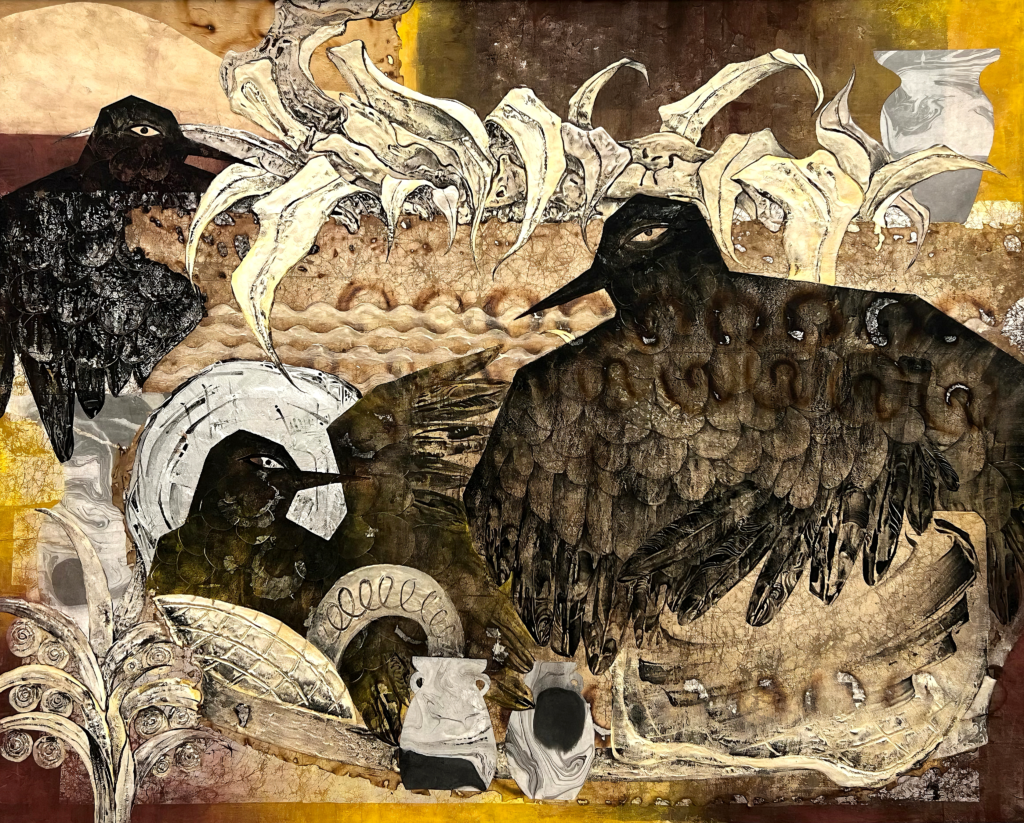
The Raven’s Ablution, 2025, Mineral pigments, ink, silver on silk and kumohada hemp paper, 162 × 130 cm
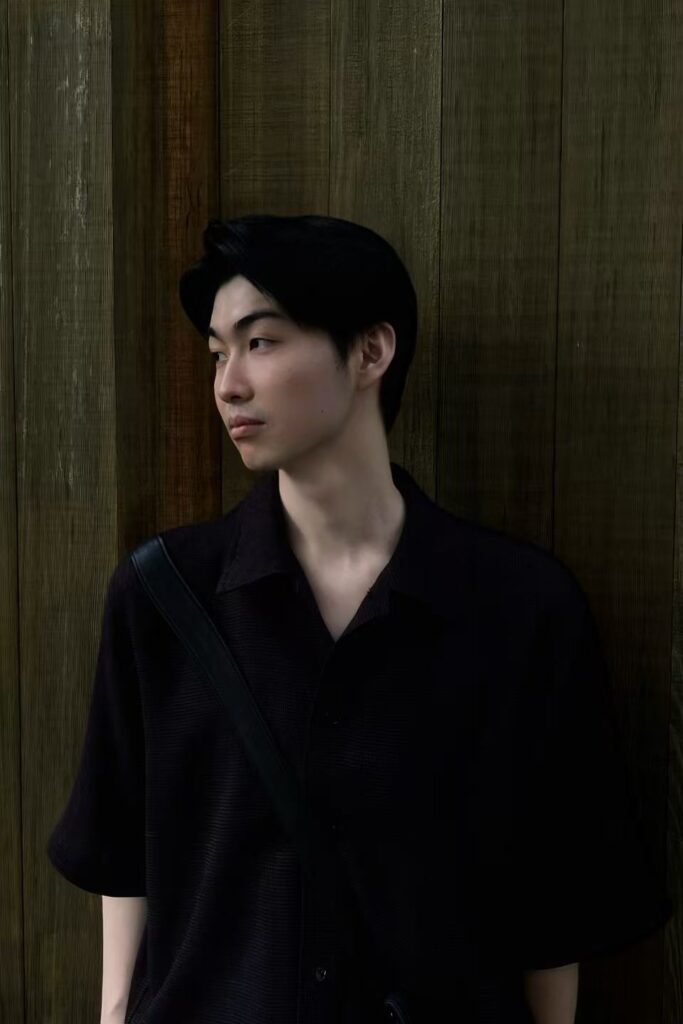
Li Dan
Li Dan (b. 1997) is a contemporary painter based in Japan, and a master’s student in Japanese Painting at Joshibi University of Art and Design. His work, centered on self-love, explores the balance between time, matter, emotion, and memory.
Recurring motifs such as crows, bottles, and plants reflect reflections on the self and its relation to the world. Using mineral pigments and ink on silk and hemp paper, he experiments with layering, staining, and burning to create tension between natural processes and human control. His paintings offer an experience of existence, where matter, emotion, and time resonate in a single space.
Education
2024, Master’s Program in Japanese Painting, Graduate School of Art and Design, Joshibi University of Art and Design, Tokyo, Japan
2020, Chinese Painting (B.A. in Art), Department of Chinese Painting, Xi’an Academy of Fine Arts
Li Dan (b. 1997, Xi’an, China) is a contemporary painter based in Japan and a master’s student in Japanese Painting at Joshibi University of Art and Design. Centered on self-love, his work explores the subtle balance between time and matter, emotion and memory. Recurring motifs such as crows, bottles, and plants reflect a meditation on the relationship between the self and the world.
Li primarily works with mineral pigments and ink on silk and hemp paper, experimenting with staining, burning, and layering techniques to create tension between natural processes and human control. The flow of pigment, the movement of water, traces of fire, and the breath of the paper together form the language of the “thing” itself, materializing time as a perceptible silence.
Rather than depicting visible objects, Li’s paintings offer an experience of existence. He seeks to make matter, emotion, and time resonate within a single space, producing works that are gentle yet introspective, residual yet generative, while exploring the spiritual dimension of painting in a contemporary context.
Since 2024, Li has continued his studies in Japanese painting at Joshibi University, using crows as symbols of the self to reflect inner solitude and emotional fluctuations. Bottles, plants, and everyday objects expand his expressive vocabulary, linking personal emotions with spatial environments, resulting in images that are both figurative and abstract. He plans to incorporate more objects in future works to deepen and broaden his narrative.
Crow, Clay, and Memory
Origins — The Crow as a Mirror of the Self
At the heart of my artistic practice lies the image of the crow. For me, the crow is not merely a bird—it is a deeply personal symbol of the self, embodying growth, transformation, and the fuctuations of identity. Throughout my body of work, I have continued to depict the crow in various forms: sometimes fgurative and detailed, other times abstract and fuid, dissolving into the space like a blurred memory.
The origins of this motif can be traced back to my childhood and hometown. In the house where I grew up, I vividly remember seeing black bird-like patterns painted on the rooftops and ceiling beams. These motifs, mysterious and silent, left a deep impression on me. However, as the city changed, my old house was torn down due to urban redevelopment. The space and its atmosphere were lost, leaving only fragments of memory.
Perhaps because of this loss, I began to cherish those moments even more. The memory of that house—and the symbols embedded in it—have grown stronger with time. Later, I even created a three-dimensional installation reconstructing the largest tree that once stood in our garden. In this way, memory has taken physical form, and the crow has become a vessel for that memory.
In my paintings, the crow is often paired with familiar domestic objects—houses, vessels, plants—as if to ask, “Where do I belong?” or “How do I inhabit space?” It is an image that questions the relationship between the self and the world. The crow refects my personal anxieties: how to be seen, how to exist within systems, and how to hold onto myself. It is a mirror of both vulnerability and strength, formed through years of internal dialogue.
Materials, Technique, and Cultural Layers
Primarily use traditional Japanese materials such as mineral pigments (iwa-enogu) and ink, applied on kumohada hemp paper, washi, or silk. Each material holds a different expressive potential. Mineral pigments carry a sense of weight and history, layering the image with sedimented time. Ink, on the other hand, is unpredictable—its fuidity and bleeding allow emotion and rhythm to surface naturally.
One of the unique techniques I use is burning silk (yaki-kinu). By applying fre or heat to the back of silk, I create textures that feel aged or eroded, like worn-out pages of memory. The resulting patterns—scorched marks, subtle holes, or dye variations—add a visceral sense of passing time and faded presence.
In addition to material techniques, my practice is also informed by ancient cultural motifs. I have been deeply inspired by Han dynasty pictorial bricks and stones from ancient China. Their composition, symmetry, and mythical imagery ofer not only aesthetic references but also a spiritual grounding. Within them, I fnd metaphors for life, death, and transformation—themes that resonate with my own exploration of identity and memory.
These references are not quoted literally; rather, I reinterpret them through my own sensibility. The result is not reproduction, but reincarnation—a personal mythology constructed through form, texture, and silence.
The vessel series, which focuses on objects like bowls, kettles, or jars, emerges from this same cultural and emotional lineage. Vessels are everyday objects, yet they preserve traces of human life: a cup used, a lid opened, a plate left behind. In painting these vessels, I attempt to hold on to the residue of gestures, the afterimage of daily acts.
The Shape of Self-Love — From Refection to Projection
The central theme running through my work is self-love. However, I do not depict it in a grand or declarative way. It is not about praising oneself, but about quietly recognizing oneself—accepting that I am here, that I exist, and that I change.
Sometimes this realization comes in small, quiet ways: tidying up a teacup after use, noticing a plant at the edge of the table, watching steam disappear into the air. These moments may be ordinary, but they are portals into the self, where emotion and memory linger.
By developing both the crow series and the vessel series, I have sought to explore diferent aspects of this idea. The crow refects transformation, memory, and internal dialogue. The vessels carry the remains of action—objects that absorb and refect traces of human life.
Moving forward, I aim to deepen this dual approach. I wish to continue experimenting with material, space, and composition while remaining grounded in cultural memory and personal experience. I am particularly interested in how my work can resonate beyond the canvas—through installation, spatial drawing, and layered surfaces that engage the body as well as the eye.
Ultimately, while my works are deeply personal, I hope they ofer mirrors for others. In the still fgure of a crow or the hollow of an emptied vessel, one might fnd a piece of their own memory, their own questions, and their own way of seeing the world.
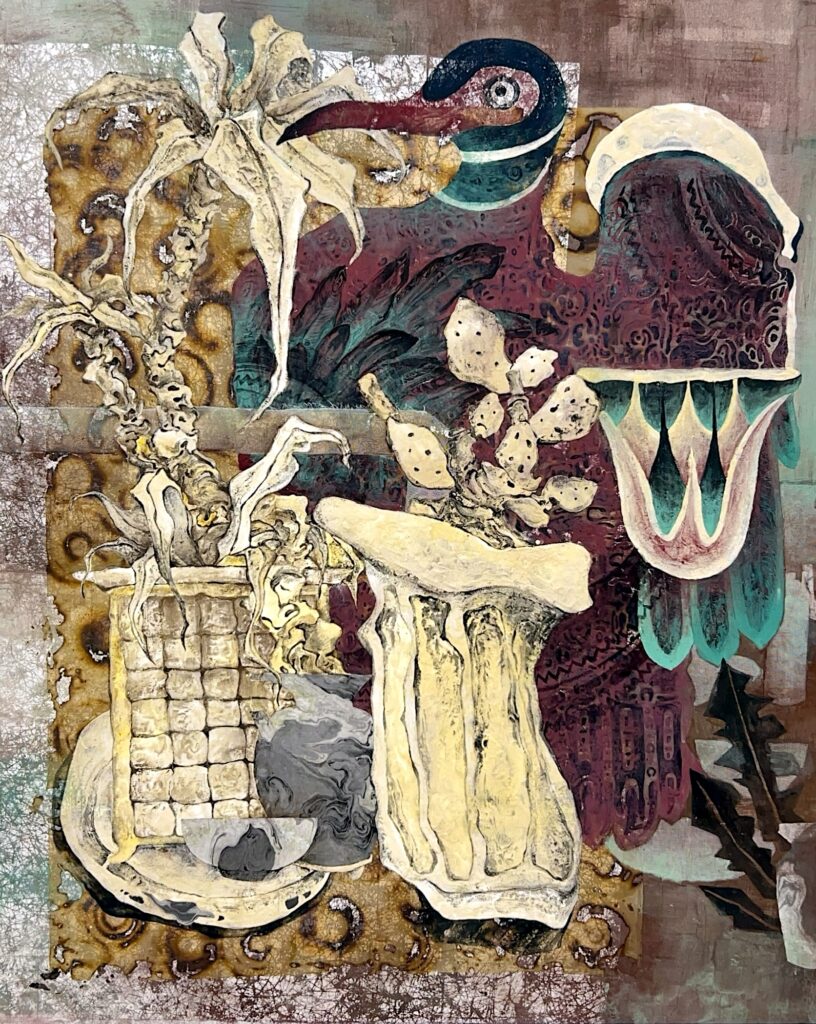
To the Sloping Path
162 x 130 cm


