Lai Chi Man
Lai Chi Man
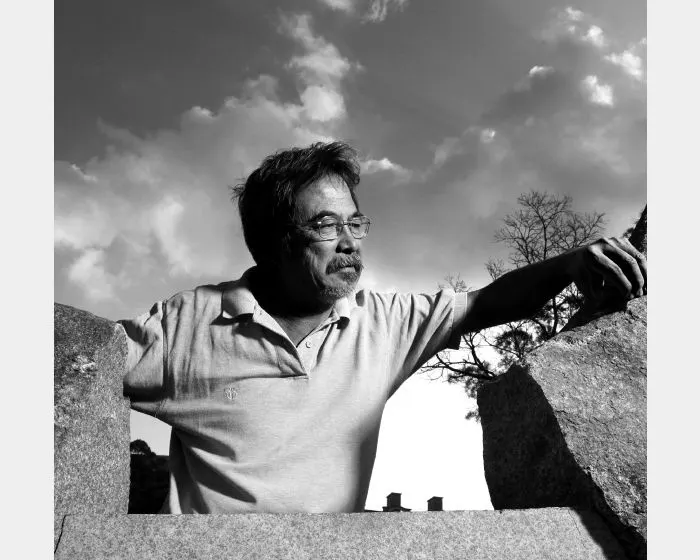
Lai Chi Man is a pivotal figure in the sculpture communities across Hong Kong, Taiwan, and Mainland China, and his work has gained broad recognition in the international art world. Having lived in Hong Kong, Italy, the United States, the Netherlands, and Taiwan, he eventually turned back toward his cultural roots in search of identity and grounding.
As one of the few Chinese artists who continue to work primarily with stone, Lai holds a deep belief in nature, choosing to engage directly with natural materials in his practice. He transforms traditional Chinese cultural symbols into a contemporary artistic language, most notably through his Between and Landscape series, where these motifs are distilled into universal values that transcend cultural boundaries.
Lai’s distinct perspective is shaped by the traditional Chinese principles of pictographic and ideographic construction—xiangxing and huiyi—from which he draws ancient wisdom and reinterprets it for the modern world. His work reflects on the relationship between individuals, nature, and the wider world. The rhythms, flows, and encircling forms of his sculptures, together with the abstract lines and shapes in his works on paper, invite viewers into open-ended spaces of imagination.
Curricula Vitae:
1949 Born in Hong Kong
1973 Sculpture Department, National Taiwan Academy of Fine Arts
1974-1977 Worked as an independent sculptor in the Henraux Studio in Carrara, Italy
1977-1979 Awarded the Robert Russin fellowship in sculpture in U.S.A
1980 Received M.F.A degree from the University of Wyoming, U.S.A
Lai Chi Man born in 1949 in Hong Kong. Lai graduated from the sculpture department of National Taiwan Academy of Arts. He later travelled to Italy where he practiced sculpture at Henraux S.p.A., Carrara, which is famous for its quarries and sculptures. During this time, Lai had the opportunity to work alongside Henry Moore, Isamu Noguchi, and Pietro Cascella.
After four years in Italy, he received a fellowship to further his education in Wyoming under the sculptor, Robert Russin. And, in 1980, he received his M.F.A degree in sculpture from University of Wyoming. During this period, he married Paulien. In 1982, he was admitted as a member of the Beeldende Kunstenaars Regeling in the Netherlands.
Lai returned to Taiwan in 1984 upon invitation to hold a teaching position at the National Institute of the Arts (now, Taipei National University of the Arts), where he still teaches today. Having experienced life in Hong Kong, Italy, the United States, the Netherlands, and Taiwan, Lai was able to foster a rich and diverse perspective on aestheticism. Nevertheless, it was always clear to Lai that he would return to embrace the Eastern spirit.
Lai declares, “Over the past thirty years in Taiwan, I have been constantly exploring and developing an artistic vocabulary. This echoes the evolution and depth of mankind’s harmonic coexistence with nature. The roots for this resulting sculptural vocabulary can be traced to the six ways of constructing Chinese characters, whose forms echo the cultural virtues of an ancient tradition and reflect the essence of Eastern thought. Through such an approach, I contemplate Eastern philosophies regarding the relationships amongst mankind and nature. And, throughout the creative process, I use pictographs and meanings similar to those found in Chinese characters to express a message that transcends culture and communicates universal values.”
Between Nature and Mind
The sculptural art of Taiwanese-based artist Lai Chi-Man mixed the formality of tradition with the sophisticated visual language and the experimental abstract to create sculpture that speaks eloquently across cultures.
By Larry D. Lutchmansingh
Thoughts of “Relations”
Viewing works by Lai Chi-Man will often observe is the presence of two parallel methods. One of them utilizes a single material, from which a method that invokes the course of change and development in life emerges. Another combines objects with two different properties, serving as a method for sparking conceptual or symbolic conflict. Lai periodically shuttles between these two methods. This shifting and merging has been absorbed into the whole of his sculpture art. In the end, these opposite methods are able to coexist, and even attaches a particular meaning to the context. As a result, the theme that runs through the heart of Lai’s works is nothing no otherness but contemplation about the notion of “between”. If they can be based on a “relational” way of thought, then what is presented will not be a fixed entity, but a constantly changing and united living entity that frequently shifts between different states.
– Toshiaki MINEMURA (Lai Chi-Man Calmly Moving Forward)
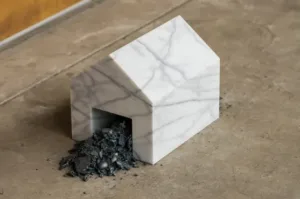
Golden House
2019
Marble & Iron Scum
23 x 12 x 27 cm
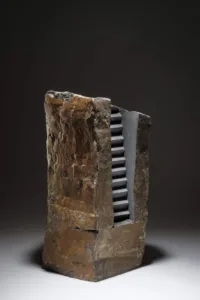
Landscape
2018
Basalt
50 x 30 x 25 cm
Budding