Upcoming

Ink After the Contemporary

Group Exhibition

Chen Hanqing
Dai Yinglun
Li Dan
Liu Ting
Pang Xiaochen
Zeng Jianyong

04 Mar – 29 Mar 2026
Tue – Sun: 11am – 7pm

Poster

Exhibition Details:

Ink After the Contemporary

Group Exhibition

Artists: Chen Hanqing | Dai Yinglun | Li Dan | Liu Ting | Pang Xiaochen | Zeng Jianyong

Curator: Rick Shi
Curatorial Team: Audrey Zhang, Yan Li, Kenneth Liu, Freya Zhang, Shuyu Liu, Grace Shen

Opening Reception

Wednesday, 04 Mar 2026

15:00 – 20:00

​Prestige Gallery (39 Keppel Rd #03-01, Tanjong Pagar Distripark, Singapore 089065)

RSVP​ | Please click here

Ink art, as one of the most representative visual languages within the Chinese artistic tradition, has continuously evolved throughout history. From the formation of its brush-and-ink tradition, to the emergence of literati ideals, and later its encounters with modern and contemporary art, ink has never ceased to reinvent itself.

Titled Ink After the Contemporary, this exhibition brings together the distinct practices of six contemporary ink artists. As contemporary ink has gradually settled into relatively stable modes of expression, these artists critically reflect on and push beyond its established language, approaching ink not as a fixed medium, but as a visual and conceptual system open to reinterpretation and re-articulation across contexts.

In their methodologies, the participating artists boldly introduce flattened, vivid color palettes, emphasizing form, line, blocks of color, and the structural relationships between volume and plane. Through the reconfiguration of formal language, they articulate individual experience, emotion, and states of consciousness. In this way, Ink After the Contemporary becomes both a reconsideration of the established aesthetic conventions of contemporary ink and an attempt to propel it forward.

Although each artist’s ink language takes on a distinct form, their practices can still be traced back to the underlying logic of ink technique and the philosophical core of the Chinese ink tradition. This relationship is not a replication of tradition, but an ongoing process of evolution within a contemporary context, allowing ink to retain its historical depth while acquiring new visual forms.

Ink originates in China, but it is not confined by geography or history. Through the practice of Ink After the Contemporary, this exhibition seeks to engage with the visual culture of contemporary Southeast Asian society in ways that are more open and inclusive, exploring the future potential of ink as it navigates continuity and transformation.

Featured Artists

Chen Hanqing

Chen Hanqing 陈汉青 (b. 1996) was born in Quanzhou and began his training in traditional ink painting at an early age. Through sustained practice, he has developed a distinctive approach to contemporary ink that treats tradition not as a stylistic archive, but as a living system of thought. Centred on the rational spirit of Song-dynasty literati painting, his work seeks to reactivate the worldview of ‘gewu zhizhi’ — investigating things to understand principles — within a present-day context. His compositions are marked by restraint and structural clarity, combining the condensed brush language associated with Bada Shanren and the disciplined pictorial order of Song ink traditions. Flowers, weathered rocks and solitary birds recur as primary motifs, rendered with dry brush, feibai (flying white), and subtle tonal modulation. Through sparse spatial arrangements and controlled ink gradations, Chen transforms states of solitude, hesitation and introspection into quiet visual meditations.

In his recent flower-and-rock series, Chen draws inspiration from the compositional layering and colour sensibility of Lê Phổ, incorporating aspects of Southeast Asian ink traditions into his practice. This cross-regional dialogue reflects his understanding of ink painting as an open and evolving system rather than a closed historical canon. Maintaining a balance between gongbi (meticulous rendering) and xieyi (expressive execution), and working on both silk and paper with restrained colour, he preserves the material integrity of ink while introducing a contemporary spatial and conceptual awareness. Rather than seeking reconciliation between past and present, Chen sustains a productive tension between the rational discipline of classical literati painting and the critical sensibility of contemporary ink art.

Sumeru Reverie · A Celestial Steed on the Clouds 2026 Ink and colour on paper 35.5 x 44 cm

Sumeru Reverie · A Celestial Steed on the Clouds
2026
Ink and colour on paper
35.5 x 44 cm

The Subtle Glimmer of Intent Amidst the Flowers Ink and colour on silk 60 x 80 cm 2025

The Subtle Glimmer of Intent Amidst the Flowers
2025
Ink and colour on silk
60 x 80 cm

Dai Yinglun

Dai Yinglun 代英伦 (b. 1987) graduated from the Chinese Painting programme at the Luxun Academy of Fine Arts, where he specialised in the formal language of contemporary figure painting. Growing up in a small city with a relatively fixed social structure shaped his sustained attention to human relationships and collective behaviour. Grounded in personal experience, his practice examines the interaction between social systems and individual psychology. Through densely populated compositions and carefully orchestrated group dynamics, he constructs scenes in which everyday situations unfold with heightened dramatic intensity. Facial expressions, gestures and subtle interpersonal tensions accumulate within the pictorial field, allowing his figures to embody layered states of consciousness and emotional complexity.

Visually, Dai’s narrative method recalls the panoramic observation found in Pieter Bruegel the Elder, particularly in his detailed depictions of communal life. At the same time, his compositional logic engages with the spatial sequencing of Zhang Zeduan’s Along the River During the Qingming Festival, where multiple narrative threads coexist within a coherent structural order. Rather than producing allegory, Dai situates this mode of collective representation firmly within contemporary reality. Working within the expanded field of post-contemporary ink, he treats the medium not merely as a site of formal experimentation but as a methodology for analysing society and articulating the psychological texture of present-day existence.

The Crowd, Ever in Cycle 2025 Ink and color on paper 68x45cm

The Crowd, Ever in Cycle
2025
Ink and color on paper
68 x 45 cm


The Crowd, Because Nothing Is Gained 2025 Ink and colour on paper 68x45cm

The Crowd, Because Nothing Is Gained
2025
Ink and colour on paper
68 x 45 cm

Li Dan

Li Dan 李丹 (b. 1997) was born in Xi’an and later pursued specialised training in mineral pigment painting in Japan. Through cross-cultural training and sustained material research, he has developed a practice centred on mineral pigments and ink, interwoven with experimental approaches associated with Post-Contemporary Ink Painting. Working primarily on silk scrolls and hemp paper, he engages in repeated processes of staining, burning and layered application, allowing water, fire and time to participate actively in the formation of the image. Rather than prioritising compositional completion, Li regards painting as an open and process-based field. The seepage of pigment, the movement of water and the traces left by flame generate a dynamic tension between natural emergence and human intervention, transforming the pictorial surface into a site of material negotiation.

From an art historical perspective, rock pigment painting originated in early China and reached a peak during the Sui and Tang dynasties, exemplified in Buddhist mural traditions such as the Mogao Caves, the Yungang Grottoes and the Longmen Grottoes. Li  does not treat this lineage as a subject of revival or nostalgia. Instead, he reactivates rock pigment within a contemporary experimental framework, releasing ink from its conventional brush-and-ink hierarchy and placing it alongside mineral colour as an equivalent material presence. In his work, time becomes visible through sedimentation, scorching and layered accumulation, while material processes themselves assume narrative agency. Traversing both the historical tradition of rock pigment and the expanded discourse of Post-Contemporary Ink, Li’s practice redefines painting as an inquiry into material intelligence, perception and becoming.

The Raven’s Ablution 渡鸦的洗礼 Li Dan 2025, Mineral pigments, ink, silver on silk and kumohada hemp paper 130 x 162 cm

The Raven’s Ablution
2025
Mineral pigments, ink, silver on silk and kumohada hemp paper
130 x 162 cm

To the Sloping Path 黎明的振翅 Li Dan 2025, Mineral pigments, ink, silver on silk and kumohada hemp paper 162 x 130 cm

To the Sloping Path
2025
Mineral pigments, ink, silver on silk and kumohada hemp paper
162 x 130 cm

Liu Ting
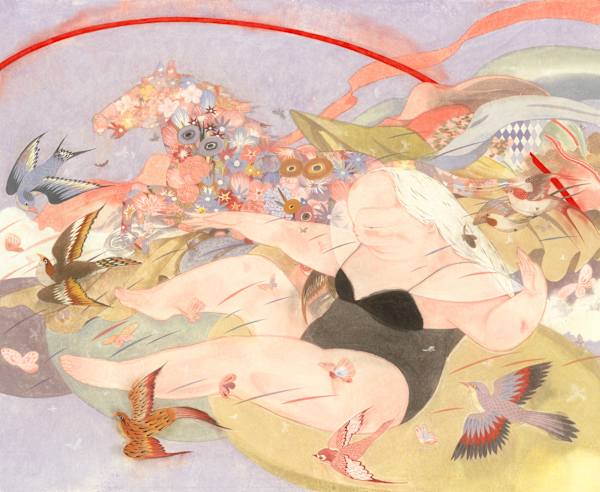
Liu Ting 刘亭 (b. 1983) was born in Shandong and graduated from the Traditional Chinese Painting department at Shandong University of the Arts. Working primarily in ink on xuan paper, she established a distinctive visual vocabulary early in her career through an ongoing series of rounded, voluptuous female figures. Situated between reality and imagination, these figures construct a feminine realm grounded in contemporary lived experience. While her exaggerated corporeal volume inevitably recalls Fernando Botero, Liu’s orientation diverges fundamentally from satire or allegory. Rather than critiquing power structures, she centres on the emotional states, expectations and self-perceptions of contemporary youth. The body becomes a site of subjectivity and self-recognition, generating images that are intimate, introspective and quietly affirmative.

At the same time, Liu’s ink practice resonates with the spirit-focused principles of Gu Kaizhi, particularly the emphasis on “depicting the spirit through form.” Through calibrated variations of ink density, dryness and layering, she creates a restrained psychological space in which stillness carries emotional weight. Moving beyond orthodox literati tonal hierarchies, she reintroduces colour as an integral structural and atmospheric element, allowing ink to function not only as contour but as a comprehensive medium shaping space and mood. Within the expanded discourse of post-contemporary ink, Liu transforms female consciousness and bodily experience into the internal driving force of her work. Her paintings do not deliver fixed narratives; instead, they offer an open and elastic field in which body, emotion and identity remain in active negotiation.

Blossoming Soon 马上花开 Liu Ting 2025, Ink and color on paper 127 x 153 cm

Blossoming Soon
2025
Ink and colour on paper
127 x 153 cm

Struggle 挣斗,2019, Ink and color on paper,120x240cm

Struggle
2019
Ink and colour on paper
120 x 240 cm

A Pot at Boil 煮一锅沸腾的汤 Liu Ting 2024, Ink and colour on paper 122 x 61 cm

A Pot at Boil
2024
Ink and colour on paper
122 x 61 cm

Pang Xiaochen

Pang Xiaochen 庞啸晨 (b. 1990) was born in Hebei, China, and graduated from the Central Academy of Fine Arts, where he studied under Liu Qinghe. Through rigorous academic training, he mastered the brush-and-ink structures of xieyi (freehand) ink painting while inheriting a lineage of thought rooted in Song, Yuan, Ming and Qing literati traditions. For Pang, ink is not merely a stylistic vehicle but a way of knowing and engaging the world. Extending this intellectual trajectory into the present, he employs xieyi ink painting as a methodology for observing contemporary life, transforming brush and ink into instruments for reflecting on social structures and individual experience.

His subjects include passers-by from everyday life, iconic figures from art history and animals, all rendered with a suspended presence that oscillates between observation and introspection. Through layered applications of ink and colour, and the deliberate act of “seeking the white edge” (xunzhao baibian), he creates forms that hover between definition and dissolution. This interstitial space generates a quiet yet sustained narrative force, encouraging a slower mode of viewing. Art-historically, his figure paintings resonate with the socially engaged ink tradition exemplified by Jiang Zhaohe, though without direct stylistic replication. Instead, Pang inherits the methodological core of using ink to engage lived reality. Rooted in the epistemological foundations of literati xieyi painting while attentive to modern social consciousness, his practice reactivates ink as a reflective and perceptual field within contemporary life.

Crimson Cloud Charger 飞霞骠 Pang Xiaochen 2026, ink on paper 34 x 69 cm

Crimson Cloud Charger
2026
Ink on paper
34 x 69 cm

留给你们 For You Pang Xiaochen 2025, ink on paper 95 x 90 cm

For You
2025
Ink on paper
95 x 90 cm

无意识是为了想起 Unconsciousness Is a Way of Remembering Pang Xiaochen 2025, Ink on paper 95 x 90 cm

Unconsciousness Is a Way of Remembering
2025
Ink on paper
95 x 90 cm

Zeng Jianyong

Zeng Jianyong 曾健勇 (b. 1971) was born in Guangdong, China. He graduated from the Chinese Painting programme at Huaqiao University and later pursued further studies in the Printmaking Department at the Central Academy of Fine Arts. Widely regarded as a significant figure in contemporary Chinese ink art, Zeng has consistently focused on expanding the language of ink beyond the flat pictorial surface. By integrating painting, paper-sculptural construction and spatial installation, he “spatialises” ink, transforming it from a representational medium into an experiential spatial mechanism. His compressed yet immersive environments unfold along a horizon line, forming intermediary zones between reality and imagination in which viewers are visually enveloped though not physically admitted.

Drawing conceptually on the spatial consciousness of Song dynasty landscape masters such as Li Cheng, Fan Kuan and Guo Xi, Zeng abstracts principles of the “Three Distances” to construct multi-layered viewing systems. Mountains, figures and scenic elements function as structural nodes within shifting spatial orders rather than as descriptive motifs. Through layering, occlusion and sectional division, he destabilises single-point perspective and reconfigures traditional shan shui experience into a psychological theatre of perception. Extending ink into paper-sculptural and installation-based practices, Zeng has developed a distinctive artistic system in which landscape, figure and memory converge to create immersive “theatrical sites” charged with cultural resonance and spatial tension.

Path through the Fields 野径 Zeng Jianyong 2024, Ink and colour on paper 120 x 80 cm

Path through the Fields
2024
Ink and colour on paper
120 x 80 cm

Folk Landscape – Wild Growth 诸野之芜 Zeng Jianyong 2024, Ink and colour on paper 130 x 90 cm

Folk Landscape – Wild Growth
2024
Ink and colour on paper
130 x 90 cm

Folk Landscape – Beyond 诸野之尽 Zeng Jianyong 2021, Ink and colour on paper 56 x 140 cm

Folk Landscape – Beyond
2021
Ink and colour on paper
56 x 140 cm